Accident and incident are nouns for something that happened, and they differ in cause: an accident is not done on purpose, whereas an incident is an event worth recording. The two words appear side by side in news stories and workplace reports, which is where the mix-up starts.
An accident is unplanned and usually harmful, as in “a car accident”. An incident, on the other hand, can be deliberate, as in a theft or an argument, and the word does not state the cause. A near miss, where nobody is harmed, is usually reported as an incident at work.
By the end, you will learn why “the robbery was an accident” and “he spilled the milk by incident” are wrong, master the difference at work and the term near miss, and memorize a trick for each word, so you will use accident and incident correctly in a report or a news story.
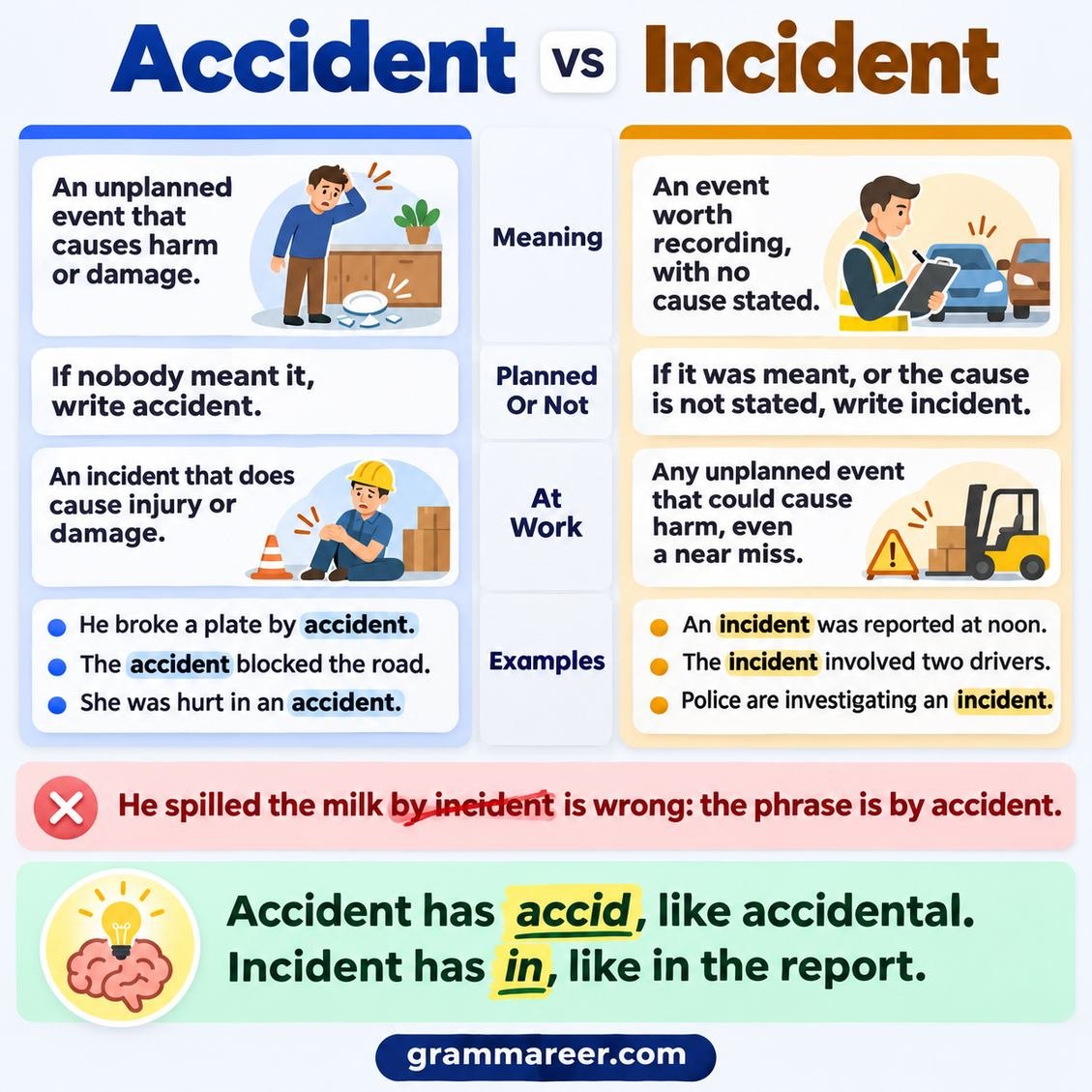
Table of Contents
Difference Between Accident And Incident
| Case | Choice | Example |
|---|---|---|
| not meant to happen | accident | The spill was an accident. |
| it was done on purpose | incident | The fight was a violent incident. |
| the cause is not stated | incident | Police are investigating an incident. |
| something minor in a report | incident | An incident was logged at 9 p.m. |
| an event with injury, unplanned | accident | He was hurt in a workplace accident. |
| by chance | by accident | I met her by accident. |
Accident Or Incident For The Same Event
The two words overlap whenever one event fits both descriptions, and a road crash is a clear case. The police call it an incident in a report, while a driver calls it an accident when describing what happened. Because both words are nouns for an event, the overlap is large, and the difference is important only when the cause matters.
Planned And Unplanned Events
Ask whether anyone meant it to happen. If the answer is no, the word is accident. By contrast, if the only known fact is that something took place, or the event was meant, the word is incident.
| The sentence | Was it meant? | What to write |
|---|---|---|
| The car ___ blocked the road. | no | accident |
| A security ___ led to arrests. | yes | incident |
| She broke the vase in an ___. | no | accident |
| The ___ was reported to the manager. | not stated | incident |
The robbery was an accident. ❌
The robbery was an incident. ✅
A robbery is done on purpose, so the word cannot be accident.
He spilled the milk by incident. ❌
He spilled the milk by accident. ✅
By accident means done without meaning to.
Meaning Of Accident
Accident is a noun that means an unplanned event that causes harm or damage, as in “a car accident“. It is also the word for chance, as in “we met by accident“, and it is the word used in insurance and safety rules.
Meaning Of Incident
Incident is a noun that means an event, especially a minor one, or one that is recorded, as in “an incident at the airport”. It is neutral about the cause, and it can be a disturbance, as in “a violent incident“, or a plain event, as in “an unfortunate incident“.
Accident Vs Incident At Work
In safety writing, the two words have narrower meanings. An incident is any unplanned event that could cause harm, and an accident is an incident that does cause injury or damage. Reports in this field usually record both kinds, because a hazard is often clear from a minor incident before anyone is hurt.
Near Miss
A near miss is an incident in which harm was narrowly avoided, as in a tool that falls and misses a worker. It is not an accident, because no one is hurt, but it is treated as an early warning and recorded.
Memory Trick For Accident And Incident
Accident has accid, like accidental: it was not meant to happen.
Incident has in, like in the report: an event written down.
If intention is not stated, incident is the safer word.
Examples Of Accident And Incident
| Accident | Incident |
|---|---|
| He broke a plate by accident. | An incident was reported at noon. |
| The accident blocked the road. | The incident involved two drivers. |
| She was hurt in an accident. | Police are investigating an incident. |
| It was a happy accident. | The incident caused a delay. |
FAQs
Yes, an accident is an incident, since any accident can be called an incident. The reverse does not hold, because an incident can be deliberate, as in a theft or an argument.
Yes, an incident can be on purpose, because the word is neutral about the cause. A theft or an argument is an incident even though nobody could call it an accident.
Police often use incident because the word is neutral about the cause. In a report a road crash is therefore called an incident, while a driver describing what happened calls it an accident.
By accident is the correct phrase, since it means done without meaning to, as in "He spilled the milk by accident". By incident is not used for this meaning.
Yes, incident is common in reports and official writing, where the cause may not be known. A line such as "An incident was logged at 9 p.m." states what happened without saying why.
Yes, a near miss is an incident, one in which harm was narrowly avoided and no injury or damage occurred. It is not an accident, but it is recorded as an early warning, as with a tool that falls and misses a worker.
Related: