Allowed and aloud are homophones, so the spelling is the only difference between them.
Allowed is the past tense of the verb allow, and it means permitted, as in “pets are not allowed”. Aloud, on the other hand, is an adverb that means in a voice that can be heard, as in “read the poem aloud”. Both words can appear in one sentence, as in “reading aloud is not allowed”, and that is where most mistakes are made.
By the end, you will learn why “phones are not aloud in class” and “she read the poem allowed” are wrong, master “read aloud”, “not allowed”, and “out loud”, and memorize a trick for each word, so you will write allowed and aloud correctly in a message or an essay.
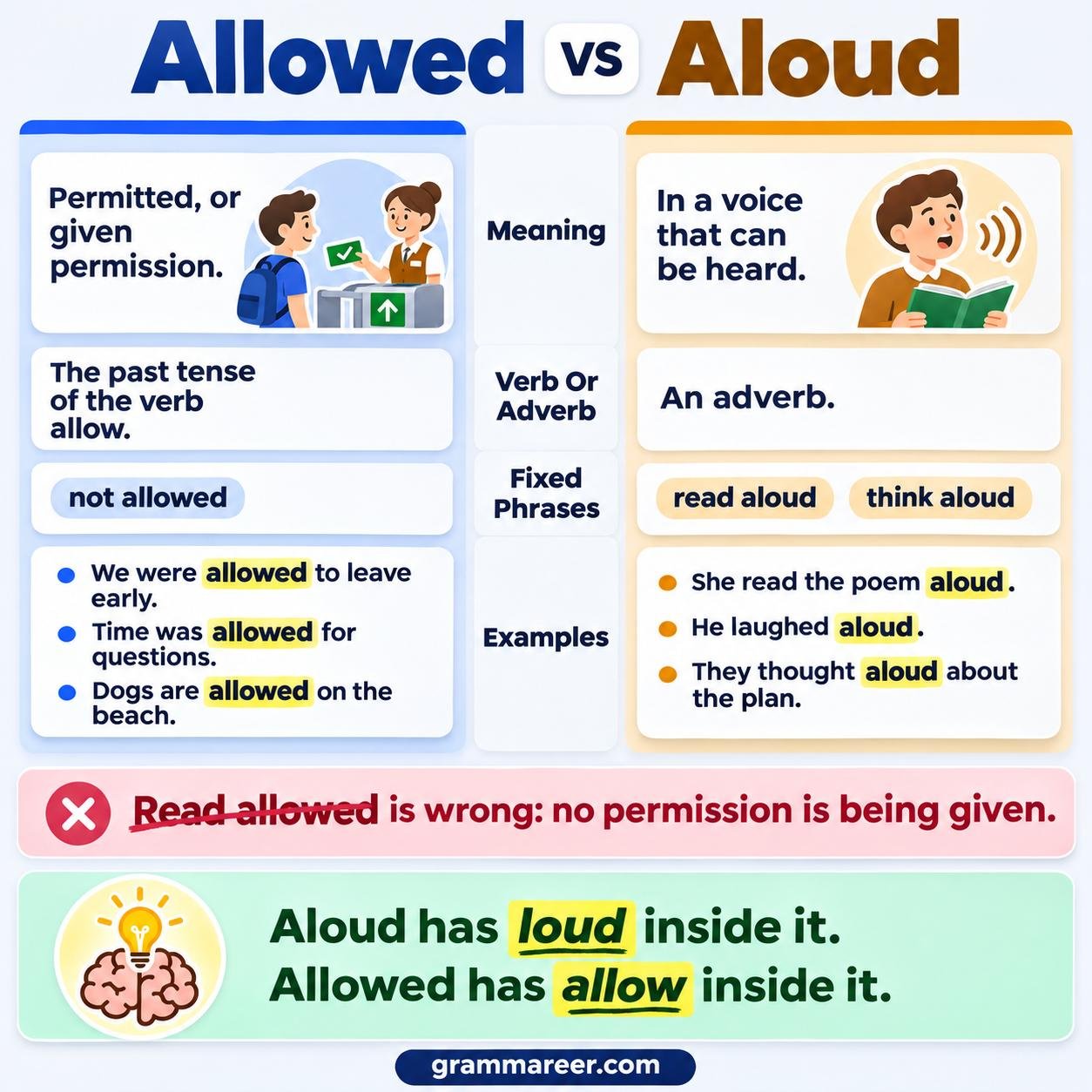
Table of Contents
Difference Between Allowed And Aloud
The difference between allowed and aloud is meaning and part of speech, since the two sound the same. Allowed means permitted, whereas aloud means in a voice that can be heard.
| Feature | Allowed | Aloud |
|---|---|---|
| Meaning | permitted, or given permission | in a speaking voice that others can hear |
| Part of speech | the past tense of the verb “allow” | an adverb |
| Spelling | has “allow” inside it | has “loud” inside it |
| Fixed phrases | not allowed, allowed to leave | read aloud, think aloud |
| Example | Phones are not allowed in class. | She read the poem aloud. |
Meaning Of Allowed
Allowed is the past tense and past participle of the verb allow, which means to permit. It appears after to be, as in “she was allowed to leave”, and before to, as in “pets are not allowed“. It also means set aside, as in “two hours were allowed for the trip”.
Meaning Of Aloud
Aloud is an adverb that means in a speaking voice that others can hear, as in “she read the letter aloud” and “he laughed aloud“. It is the opposite of silently. Merriam-Webster records the phrase think aloud, also written think out loud.
Memory Trick For Allowed And Aloud
Aloud has loud inside it.
Allowed has allow inside it.
If the word is about sound, look for loud, while if it is about permission, look for allow.
Is It Read Aloud Or Read Allowed?
It is read aloud. The phrase means to read in a voice that can be heard, as in “the teacher read the story aloud”. No permission is being given, so allowed is wrong here.
Is It Not Allowed Or Not Aloud?
It is not allowed. The phrase means that permission is refused, as in “food is not allowed in the library”, so aloud is wrong after not in that meaning.
Is It Out Loud Or Aloud?
Both are correct, and both mean in a voice that can be heard. Still, the phrase itself is out loud, never out loudly.
Word Family Of Allow And Loud
| Word | Meaning |
|---|---|
| allow | to give permission |
| allowable | able to be allowed |
| allowance | money or time set aside |
| loud | strong in sound |
| loudly | in a loud way |
Examples Of Allowed And Aloud
| Allowed | Aloud |
|---|---|
| Phones are not allowed in class. | She read the poem aloud. |
| We were allowed to leave early. | He laughed aloud. |
| Time was allowed for questions. | They thought aloud about the plan. |
| Dogs are allowed on the beach. | Please say your name aloud. |
Phones are not aloud in class. ❌
Phones are not allowed in class. ✅
The word means permitted, so the spelling is allowed.
She read the poem allowed. ❌
She read the poem aloud. ✅
The word means in a voice that can be heard, so the spelling is aloud.
FAQs
Yes, allowed and aloud are homophones, since both are pronounced the same way. Only the spelling shows whether permission or speaking is meant, as in dogs are allowed and read it aloud.
It is read aloud, because the phrase is about speaking in a voice that can be heard, not about permission. "The teacher read the story aloud" is a typical sentence.
Yes, out loud means the same thing as aloud, although out loud is more common in speech. Both mean in a voice that can be heard, as in think aloud and think out loud.
The phrase is out loud, not out loudly, because the word loud is used here as an adverb. The form loudly exists as a separate word meaning in a loud way, but it is not part of this phrase.
Aloud is an adverb, whereas allowed is a verb form, the past tense and past participle of allow. So "She read the poem aloud" describes how something was said, while "We were allowed to leave early" describes permission.
Related: