Already and all ready are pronounced the same way, and the only difference between them is the space: already is one adverb, and all ready is two words.
Already means before now or earlier than expected, as in “the train had already left”. All ready means that everyone or everything is prepared, as in “the bags are all ready”, and it is the word all plus the adjective ready. If the sentence still makes sense without all, as in “the bags are ready”, the two-word form is correct.
By the end, you will learn why “the bags are already for the airport” and “are we already to go?” are wrong, master “enough already” and the other pairs like already and all ready, and write both forms correctly in an email or an essay.
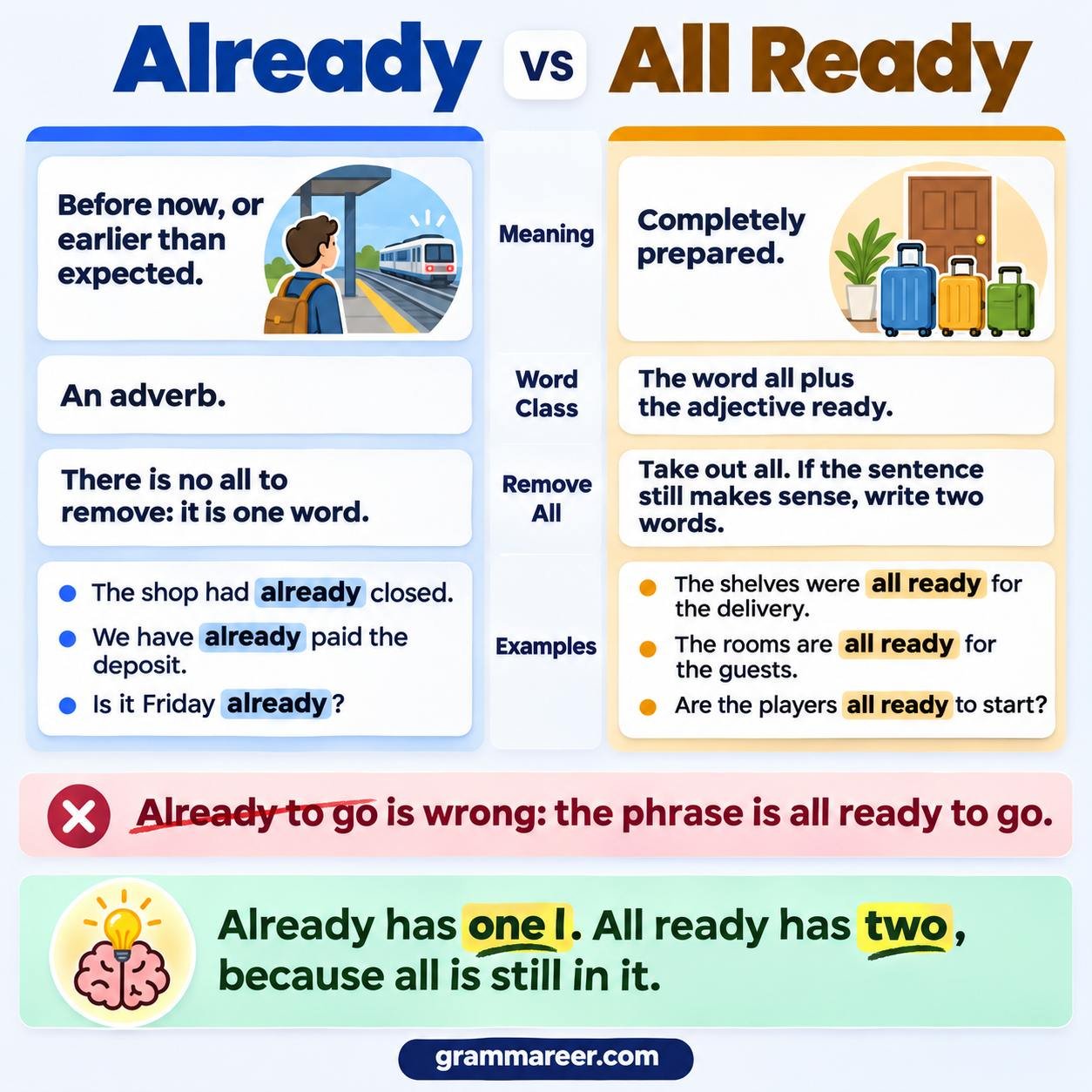
Table of Contents
When To Use Already Or All Ready
The choice between the two spellings depends on whether the sentence is about time or about being prepared. Already is the right word for something that happened before now, or earlier than expected, whereas all ready fits a sentence about being completely prepared, or about every one of a group being prepared.
One check is enough for almost every sentence. Remove all and read the sentence again: if it still makes sense, write two words.
The bags are all ready for the airport. (completely prepared) ✅
I have already packed the bags. (packed before now) ✅
Already is a single word, so there is nothing in it to remove.
Spellings Of Already And All Ready
Already and all ready are both standard English, so neither one is a misspelling of the other, and the right spelling depends on what the sentence means.
| Spelling | Part of speech | Meaning |
|---|---|---|
| Already | Adverb | Before now, or earlier than expected |
| All ready | “All” plus the adjective “ready” | Completely prepared |
Meaning Of Already
Already is an adverb that means before now, or before a time in the past, as in “I have already eaten”. The same adverb also appears where something has happened sooner than expected, as in “Is it ten o’clock already?”.
That adverb has a usual position too, between the auxiliary and the main verb, as in “I had already left”, or at the end of a question. You can also use it before an adjective for emphasis, as in “I am already late”.
- The train had already left when we got to the platform.
- I have already sent the invoices.
- Is it your birthday already?
- Nadia was already awake when the alarm rang.
- Most of the guests had already eaten by the time the speeches started.
Meaning Of All Ready
All ready is two words that mean completely prepared, as in “the bags are all ready”. It is the word all plus the adjective ready, and all means either completely or every one of a group.
The adjective follows a verb such as be, get or feel, so all ready is at the end of the clause rather than before a noun.
- The children were all ready before the bus arrived.
- Are we all ready to start?
- By seven the stage was all ready for the band.
- I will be all ready by the time you knock.
- The crates were all ready for the driver, who only had to sign for them.
Pronunciation Of Already And All Ready
Both spellings are /ɔːlˈredi/, and the sound is the same in British and American English. The two words of all ready are said without a pause in ordinary speech, so there is nothing to hear.
Because the sound is identical, choose the spelling from the meaning of the sentence. Words that match in sound and differ in spelling are homophones, and this pair matches that description even though all ready is two words.
Why Already Became One Word
In the 14th century already was written as al redy, two words that meant wholly ready. The two words were said together so often that they became one word, and only one ‘l’ is left.
All ready still has the all, in its spelling and in its meaning, so it has both ‘l’s. Already, on the other hand, has neither, so it has one.
Examples Of Already And All Ready
With already the sentence is about time, and with all ready it is about being prepared.
| Already | All ready |
|---|---|
| The shop had already closed. | The shelves were all ready for the delivery. |
| We have already paid the deposit. | The rooms are all ready for the guests. |
| Is it Friday already? | Are the players all ready to start? |
| She had already read the report. | The reports were all ready by Monday morning. |
Mistakes With Already And All Ready
The commonest slip is one word where the sentence means completely prepared, and the two-word spelling is the one left out.
The bags are already for the airport. ❌
The bags are all ready for the airport. ✅
Remove all and the sentence still makes sense, so write two words.
I have all ready eaten. ❌
I have already eaten. ✅
This sentence is about time, and all has no meaning in it.
Are we already to go? ❌
Are we all ready to go? ✅
The question is whether everyone is prepared, not whether something happened sooner than expected.
Enough Already And Other Informal Uses
Already has three more uses beyond plain time. One of them is surprise, as in “Is it ten o’clock already?”, which means the hour has arrived sooner than expected. Also common is emphasis, as in “I am already late”, where the speaker stresses that the lateness is true now and not still to come. Then there is a North American use, informal only, where already follows the word the speaker stresses, as in “Enough already!”, and means that the speaker wants something to stop.
The first two uses are standard everywhere, but the third is informal and North American, so it is out of place in an email at work or an application.
The tense differs too. The present perfect is preferred in British English, as in “I have already eaten”, and the past simple is also common in American English, as in I already ate.
Pairs Like Already And All Ready
Already is one of several one-word forms that began as all plus another word. In each pair both spellings are real, and the two-word one still has the meaning of all.
- Alright or all right: all right is the spelling that is standard everywhere, and alright is still disputed in formal writing.
- Altogether or all together: altogether means completely, and all together means in one group.
- Anymore or any more: anymore means any longer, and any more means a greater number or amount.
- Sometime or some time: sometime means at an unspecified point, and some time means a period.
A lot is different: it has no one-word form at all, and alot is never correct.
Memory Trick For Already And All Ready
All ready has two ‘l’s and already has one, and that extra ‘l’ is the clue.
All ready has both ‘l’s of all, because all is still part of what it means.
So where you can remove all, write two words, and where the sentence is about time, write already.
FAQs
Yes, already ready is correct, but it is awkward and rare. Already and ready mean different things there, so "The room was already ready" means the room had been prepared before now. Was ready already, or simply was ready, is the better choice, with no repeated sound.
The correct phrase is "all ready to go", which means completely prepared to leave. Already is wrong before to go, because that sentence is not about time.
Yes, already can come at the end of a sentence, and in questions that is the usual place, as in "Is it midnight already?" In a statement it is more often placed between the auxiliary and the main verb, as in "I had already finished".
No, British and American English do not use already in quite the same way, although the meanings are the same everywhere. "I have already eaten" is preferred in British English, while I already ate is also common in American English, so the present perfect is safe in both.
No, enough already is not suited to formal writing. It is standard in North American speech and informal writing, where it means that something has continued too long, but in formal writing of any kind it is out of place.
Yes, already can be used in questions to express surprise, as in "Have they finished already?" The same surprise appears in "Is it ten o’clock already?", where the hour has arrived sooner than expected.
Related: