Aluminium and aluminum are two spellings of one noun, the light silver metal: aluminium is British English, and aluminum is American and Canadian English. Neither is a mistake.
The British spelling has an extra i, which matches the endings of other metals such as sodium and potassium. The American spelling is shorter, and it is pronounced with one syllable fewer.
By the end, you will master the metals that end in ium, learn why “aluminium” and “aluminum” should not appear together in one text, and memorize a trick for both spellings. With that, you will keep one spelling in an essay or a product description.
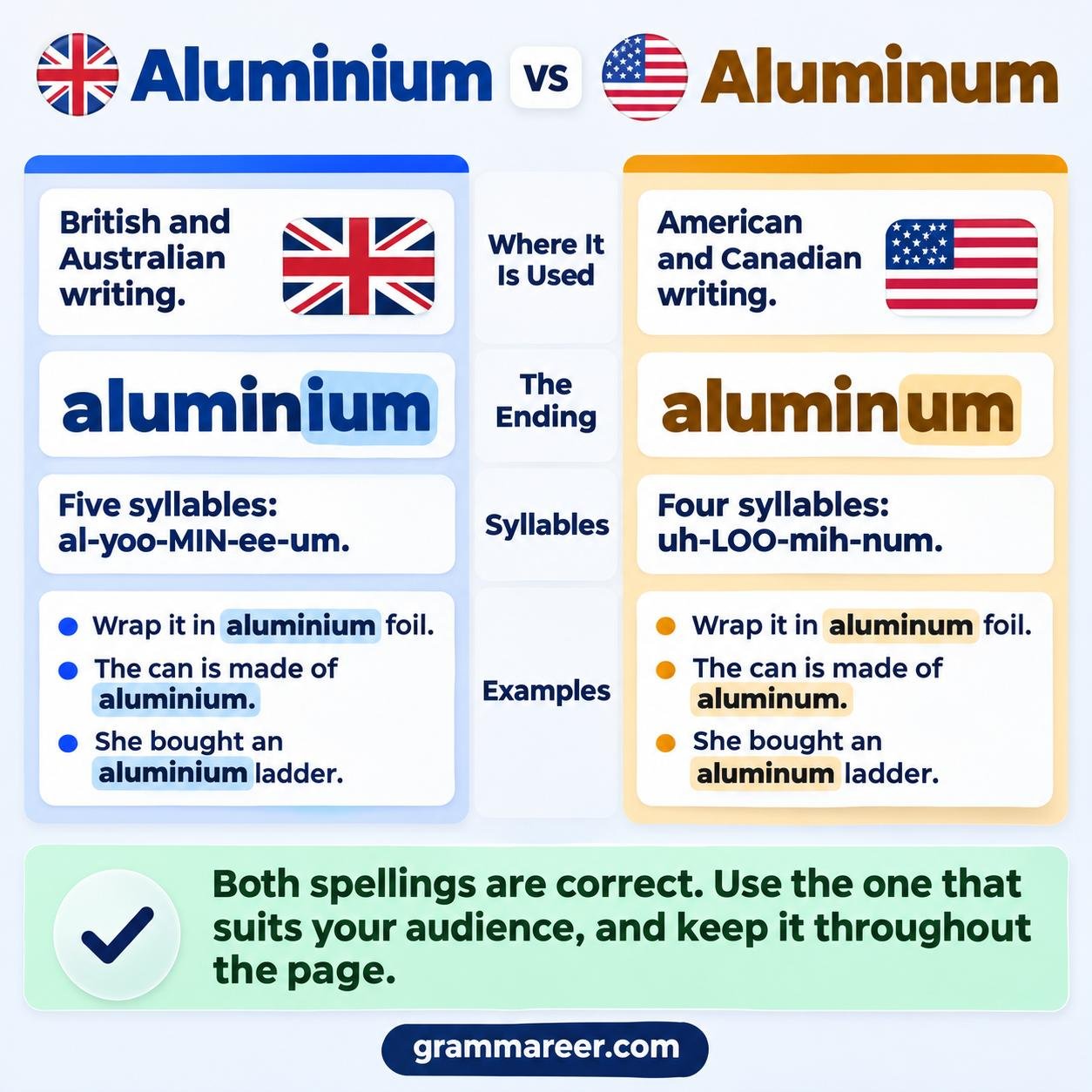
Table of Contents
Aluminium Or Aluminum In American English
Aluminum is the American spelling, as in “aluminum foil” and “aluminum cans”, and in American speech it has four syllables, as in uh-LOO-mih-num.
Aluminium Or Aluminum In British English
Aluminium is the British spelling, as in “aluminium foil” and “aluminium windows”, and in British speech it has five syllables, one more than the American form, as in al-yoo-MIN-ee-um.
Which Spelling To Use
The spelling is aluminum for an American or Canadian audience and aluminium for a British or Australian one.
| If the audience is in | Write |
|---|---|
| the United States | aluminum |
| Canada | aluminum |
| the United Kingdom | aluminium |
| Australia | aluminium |
| a mixed audience | the one in the house style |
Metals With The Ium Ending
Other metals end in -ium in every country, which is why the British spelling looks regular.
| Word | Ending |
|---|---|
| sodium | -ium |
| potassium | -ium |
| calcium | -ium |
| magnesium | -ium |
| aluminum (US) | -um |
History Of The Two Spellings
Both names come from alumina, the old word for the metal’s oxide. Sir Humphry Davy proposed alumium in 1808 and used aluminum by 1812, and a reviewer in 1811 suggested aluminium to match sodium and potassium, according to Merriam-Webster. The American Chemical Society adopted aluminum in 1925, and IUPAC accepted aluminium as the international standard in 1990.
Memory Trick For Aluminium And Aluminum
The British spelling has i-u-m, like sodium, and one more syllable.
The American spelling has no i before the “um”, and one syllable fewer.
If the page is for an American audience, choose the shorter spelling.
Examples Of Aluminium And Aluminum
| Aluminum (US) | Aluminium (UK) |
|---|---|
| Wrap it in aluminum foil. | Wrap it in aluminium foil. |
| The can is made of aluminum. | The can is made of aluminium. |
| She bought an aluminum ladder. | She bought an aluminium ladder. |
| Aluminum is light. | Aluminium is light. |
Common Mistakes With Aluminium And Aluminum
The mistake shows up on a single page where both spellings appear, or where the spelling does not match the audience.
The aluminium ladder stood next to the aluminum foil. ❌
The aluminium ladder stood next to the aluminium foil. ✅
The two spellings should not be mixed on a page, and one spelling is kept throughout.
The British page lists aluminum windows. ❌
The British page lists aluminium windows. ✅
A page for a British audience uses aluminium every time.
FAQs
Both are correct, since the two spellings differ by region. Aluminum is American and Canadian, and aluminium is British, as in aluminum foil and aluminium foil.
Aluminum has four syllables, whereas aluminium has five, because the British form has one more syllable than the American form.
Yes, it is the same metal, since both spellings mean the light silver metal, as in aluminum foil and aluminium foil.
In science, international chemistry bodies use aluminium, since IUPAC accepted it as the international standard in 1990. Aluminum, by contrast, is the spelling used in American English.
No, the two spellings should not be mixed on a page. One is picked to suit the audience and kept throughout, so a page for a British audience uses aluminium every time.
Neither spelling came first by much, since both appeared within a few years of each other in the early 1800s. Sir Humphry Davy proposed alumium in 1808 and used aluminum by 1812, and a reviewer suggested aluminium in 1811.
Related: