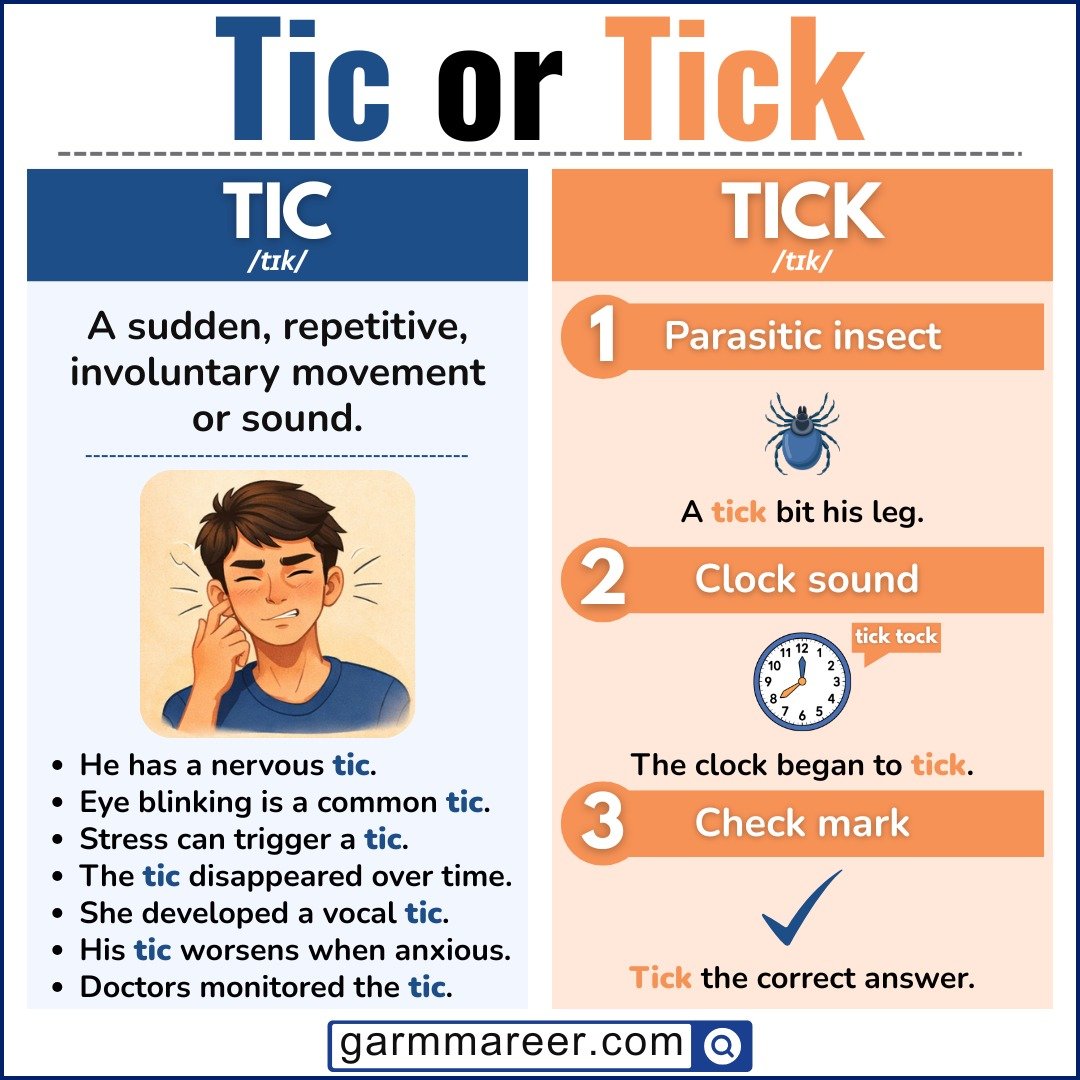
Two words that sound exactly the same, but mean completely different things. A tic is a small, sudden twitch your body makes without asking you first, like a quick eye blink or a shoulder jerk. A tick, on the other hand, can be a small mark on a checklist, the steady sound of a clock, or even a tiny insect that latches onto skin. So when you’re stuck choosing between tic or tick, the right answer almost always depends on whether you’re talking about a movement, a mark, a sound, or a bug.
People mix these up because both words are pronounced exactly the same way (/tɪk/). The trick is knowing which spelling fits which meaning, and once you see them side by side, the confusion clears up fast.
Table of Contents
Quick Answer: Tic vs Tick
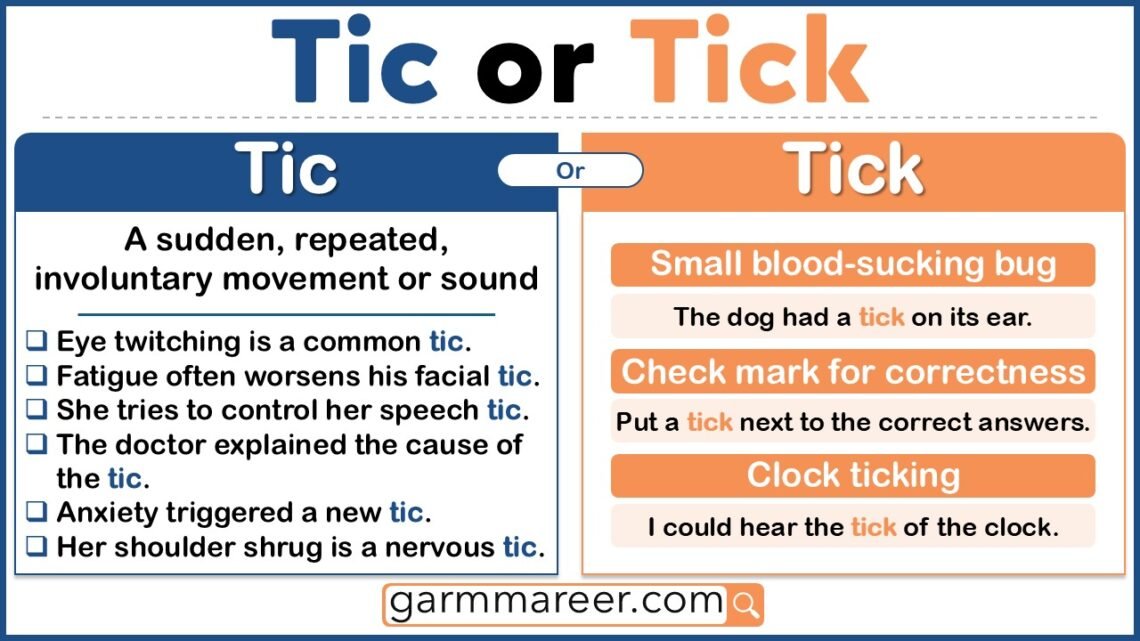
- Tic = a sudden, involuntary movement or sound made by a person.
- Tick = a checkmark (✓), a clock sound, a small insect, or the verb meaning “to mark.”
Same sound, different spellings, different worlds.
What Does Tic Mean?
A tic is a noun. It refers to a quick, repeated movement or sound that someone makes without controlling it. Tics often show up around the eyes, face, mouth, or shoulders, and they can get stronger when a person feels stressed, tired, or excited.
There are two main types worth knowing:
- Motor tic: a sudden physical movement, like blinking, head jerking, or shrugging.
- Vocal tic: an unintentional sound, like throat clearing, sniffing, or grunting.
Tics are also linked to medical conditions such as Tourette syndrome, but plenty of people experience mild, harmless tics without any diagnosis at all.
Examples:
- He has a small tic in his left eye that flares up before exams.
- Her vocal tic sounds like a soft cough every few minutes.
Notice that tic is only a noun. It’s never used as a verb in English.
What Does Tick Mean?
Tick is the busier word of the two. It works as both a noun and a verb, and it carries several different meanings depending on context. Here are the four you’ll meet most often, and notice how the word shifts shape with each one.
Tick as a Checkmark (✓)
A tick is a small mark used to show something is correct or completed. This usage is especially common in British English, while American English usually prefers the word “check.”
- Put a tick next to the items you’ve already packed.
Tick as a Clock Sound
From paper, tick moves into sound. The steady tick of a clock is the soft, repeated noise the second hand makes, and writers often reach for it when they want to set a quiet or tense scene.
- The only sound in the room was the tick of the old wall clock.
Tick as a Small Insect
Tick also lives in the natural world. A tick is a tiny parasitic bug that attaches to the skin of animals and humans. They’re common in tall grass and wooded areas, and some can carry diseases like Lyme.
- We found a tick on the dog after our hike through the woods.
Tick as a Verb
Beyond its noun forms, tick also works as a verb. It means to mark something with a checkmark, or to make a soft, repeated sound.
- Please tick the box if you agree to the terms.
- The kitchen clock ticked through the silent night.
Tic vs Tick: Side-by-Side Comparison
Sometimes the fastest way to lock in the difference is to see both words lined up. Here’s how they compare across part of speech, meaning, and a quick example.
| Word | Part of Speech | Main Meaning | Example |
|---|---|---|---|
| Tic | Noun | An involuntary movement or sound | He has a nervous tic in his eye. |
| Tick | Noun | A checkmark, clock sound, or insect | Add a tick to each finished task. |
| Tick | Verb | To mark or to make a soft repeated sound | Tick the boxes that apply. |
Common Mistakes With Tic and Tick
This is where most people slip up. Because both words sound identical, writers often type the wrong one without noticing.
- ❌ He has a nervous tick in his eye.
- ✅ He has a nervous tic in his eye.
Remember the eye-tic example from earlier? Spell it as “tick” and the sentence suddenly suggests he has a small parasitic bug stuck to his eye. Same sound, completely different meaning, and that’s exactly why this mistake matters. A nervous twitch is always spelled tic, never tick.
- ❌ Please tic the correct answer.
- ✅ Please tick the correct answer.
Marking something with a check always uses tick, never tic.
Easy Way to Remember Tic or Tick
Here’s a memory trick that sticks:
Tick has a “k” just like checK and clocK. Tic has no “k”, and a tic is something your body does on its own.
Both check and clock end in “k,” and they match the two most common meanings of tick. Anything involving the body’s involuntary movement drops the “k” and becomes tic.
Tick in British vs American English
That memory trick works everywhere, but tick itself behaves a little differently across the Atlantic. In the UK, people tick a box on a form. In the US, people check a box. The action is the same, but the words differ. So if you’re writing for a British audience, tick feels natural. For an American audience, check often replaces it, though tick is still understood.
The clock sound and the insect meanings of tick are used the same way in both versions of English.
Common Idioms With Tick
Once the basic meanings are clear, tick stretches into everyday expressions you’ll hear all the time. Each of these idioms only works with tick. Swap in tic and the phrase falls apart.
- Tick off: to mark items as done, or (informally) to annoy someone.
- Tick away: to pass slowly, like seconds on a clock.
- What makes someone tick: what motivates or drives a person.
- In a tick: in a very short moment; almost immediately.
- Ticked off: irritated or annoyed.
These phrases are worth memorizing as a unit, since the meaning of tick shifts inside each one.
Tic and Tick in Real Sentences
Here’s how each meaning sounds in everyday English. Notice how tic always points to the body, while tick shifts between marks, sounds, bugs, and idioms.
Tic in real use:
- His tic became more noticeable when he was tired.
- The doctor explained that her vocal tic was harmless.
Tick as a checkmark or verb:
- I had to tick every item on the safety checklist.
- Tick the option that best describes your experience.
Tick as a sound:
- The clock’s steady tick made it hard to fall asleep.
Tick as an insect:
- We pulled a tick off the dog’s ear after the walk.
Tick inside an idiom:
- Time ticked away while we waited for the results.
Same sound, very different meanings. Once you connect tic with the body and tick with marks, clocks, and bugs, you’ll never have to second-guess the spelling again.
FAQs
A tic is a sudden, involuntary movement or sound made by a person. A tick is a checkmark, the sound of a clock, a small insect, or the verb meaning “to mark.”
The correct spelling is nervous tic. Tick with a “k” refers to a mark, sound, or insect, not a twitch.
Yes. Tick works as a verb meaning to mark something with a check (tick the box) or to make a soft repeated sound (the clock ticked). Tic is never used as a verb.
Tick the box is more common in British English. American English usually says check the box. Both are understood worldwide.
Remember that tick shares a “k” with check and clock, its two most common meanings. Tic, with no “k,” is something your body does without you meaning to.
You May Also Like