Acronym and initialism are nouns for a short form made from the first letters of a phrase, and they differ in how we say it: an acronym is said as one word, as in NATO, whereas an initialism is said letter by letter, as in FBI.
In everyday speech, acronym is used for both kinds, so one short form may be called either name, and the narrower meaning is kept in careful writing. The sound affects the article too: we write “an FBI agent” because the first letter is said “eff”, and “a NATO member” because the first sound is “n”.
By the end, you will correct sentences such as “a FBI agent”, “an UFO”, and “the DVD’s”, master the plurals and the choice of a or an, and memorize a trick for saying the short form aloud, so you will use acronyms and initialisms correctly in an essay or a report.
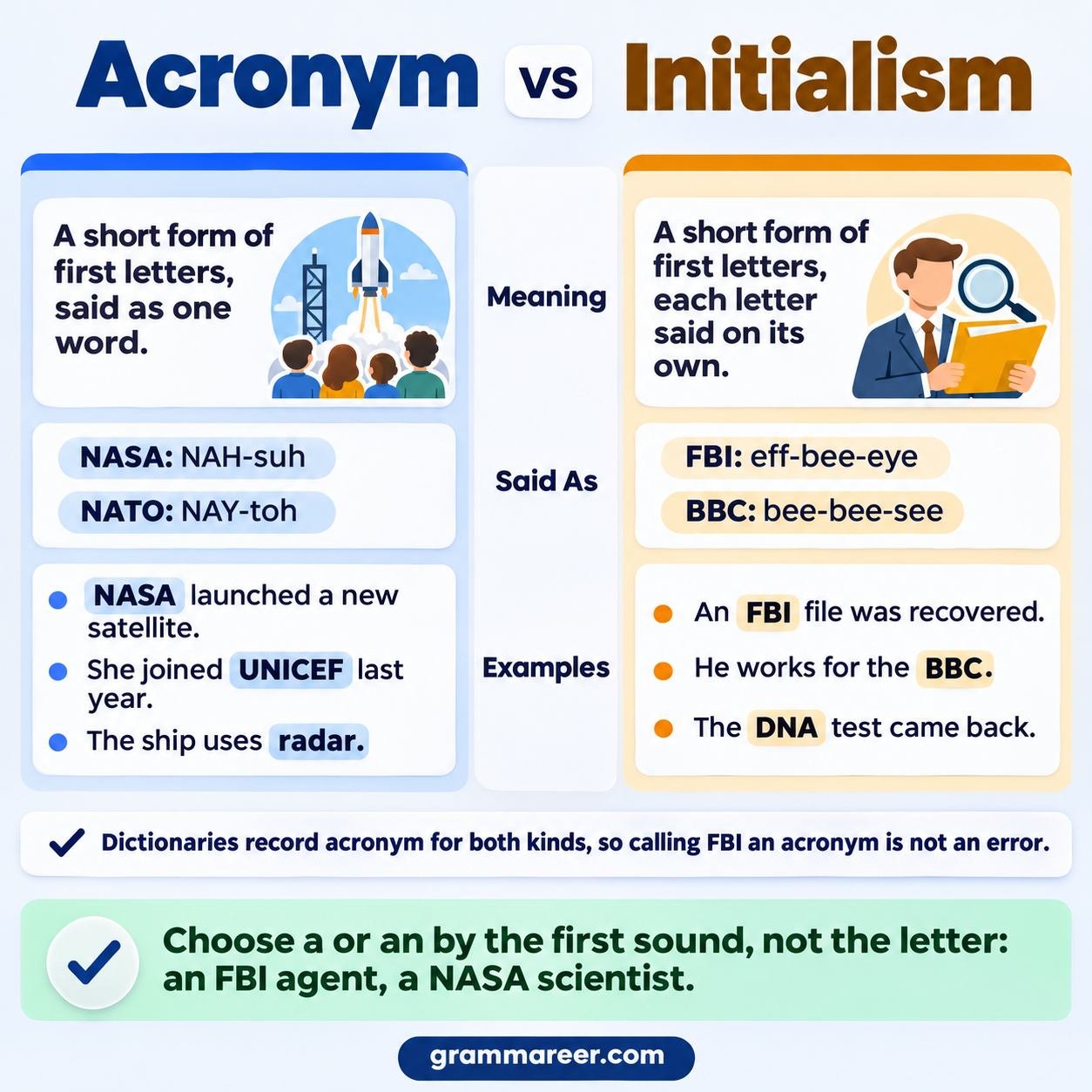
Table of Contents
Difference Between Acronym And Initialism
The difference is the sound. An acronym is pronounced as a single word, such as NATO or UNICEF, whereas an initialism has each letter pronounced on its own, such as BBC or DNA. There is no clue in the spelling, since both are usually written in capitals, so the way the short form is said is the only test.
Why Acronym Is Used For Both Kinds
Both words are terms for an abbreviation made from the first letters of the words in a name or phrase. Because both are made the same way, Merriam-Webster records acronym for both, and it notes that the broader use is common. The overlap is real, which is why calling FBI an acronym is not an error, since dictionaries record that use.
How To Tell By Saying It Aloud
Say the short form out loud and listen to how you say it. If you say it as a word, it is an acronym, but if each letter has its own sound, it is an initialism.
| Short form | How it is said | Name |
|---|---|---|
| NASA | NAH-suh | acronym |
| NATO | NAY-toh | acronym |
| FBI | eff-bee-eye | initialism |
| BBC | bee-bee-see | initialism |
| JPEG | JAY-peg | both: letters, then a word |
A few short forms are a mix of the two, such as JPEG, where the first part is said as letters and the second as a word. Those are sometimes called hybrids, and they fit neither name neatly.
Meaning Of Acronym
Acronym is a noun for a word formed from the first letters of a name or phrase, as in “NASA” and “radar“. Some acronyms have become ordinary words and are now written in lowercase, such as “laser” and “scuba“. Merriam-Webster dates the word, in its first meaning, to 1940.
Meaning Of Initialism
Initialism is a noun for an abbreviation formed from first letters, with each letter said separately, as in “ATM” and “CEO“. Merriam-Webster records the word from 1844, which is older than acronym. It is the precise word for FBI.
Acronym Vs Initialism Table
| Acronym | Initialism | |
|---|---|---|
| Made from | first letters of a phrase | first letters of a phrase |
| Said as | one word | separate letters |
| Examples | NASA, NATO, UNICEF | FBI, BBC, DNA |
| Can become lowercase | yes: laser, radar | rarely |
A Or An Before An Acronym Or Initialism
The choice between a and an follows the first sound, never the first letter. The phrase is an FBI agent because eff starts with a vowel sound, and a NASA scientist because NAH starts with a consonant sound. By the same rule, the correct forms are a UFO and an NBA player.
Plurals Of Acronyms And Initialisms
The plural of an abbreviation has a plain s with no apostrophe, as in DVDs, CDs and KPIs. The apostrophe, by contrast, is only for possessives, such as the BBC’s reporters.
How Is Either One Introduced On First Use?
On first use, the full name is written first, with the short form in parentheses straight after it, as in “Federal Bureau of Investigation (FBI)”. After that, the short form can be used alone. Acronyms are introduced the same way, as in “North Atlantic Treaty Organization (NATO)”.
Examples Of Acronym And Initialism
| Acronym | Initialism |
|---|---|
| NASA launched a new satellite. | An FBI file was recovered. |
| She joined UNICEF last year. | He works for the BBC. |
| The ship uses radar. | The DNA test came back. |
| He learned to scuba dive. | Her CEO resigned. |
Common Mistakes With Acronym And Initialism
The mistakes show up most in the choice of a or an before a short form and in the plural of an abbreviation.
A FBI agent arrived. ❌
An FBI agent arrived. ✅
The choice follows the first sound, and eff starts with a vowel sound.
The DVD’s were stacked on the shelf. ❌
The DVDs were stacked on the shelf. ✅
A plural has a plain s with no apostrophe, since the apostrophe is only for possessives.
An UFO appeared over the town. ❌
A UFO appeared over the town. ✅
UFO starts with a consonant sound, so a is the correct form.
FAQs
In everyday use, yes, an initialism is a kind of acronym, since dictionaries record acronym for both. In careful writing the two are kept apart by sound, so NATO is an acronym and FBI is an initialism.
Scuba is an acronym, because it is said as one word. It is now usually written in lowercase, in the same way as laser.
No, acronyms and initialisms are not quite the same thing, although both are abbreviations made from first letters in the same way. The key difference is the sound: an acronym is said as one word, as in NASA, whereas an initialism is said letter by letter, as in BBC.
No, not every abbreviation is an acronym or an initialism, since abbreviation is the wider term. It also includes shortened words such as "Dr." and "Mon.".
Yes, a few short forms mix the two, such as JPEG, where the first part is said as letters and the second as a word. These are sometimes called hybrids, and they fit neither name neatly.
Related: