Adverse and averse are lookalike adjectives that differ by one letter and end in the same sound. Adverse describes things that are harmful or unfavorable, whereas averse describes a person who strongly dislikes something.
Adverse comes before a noun, as in “adverse effects” and “adverse weather”. Averse comes after a person and is followed by to, as in “she is averse to change”. So a medicine has adverse side effects, whereas only a person is averse to taking it.
By the end, you will learn why “she is adverse to change” and “the medicine had averse side effects” are wrong, master the common phrases and the word family of both adjectives, and memorize a trick for each word, so you will use adverse and averse correctly in a report or an email.
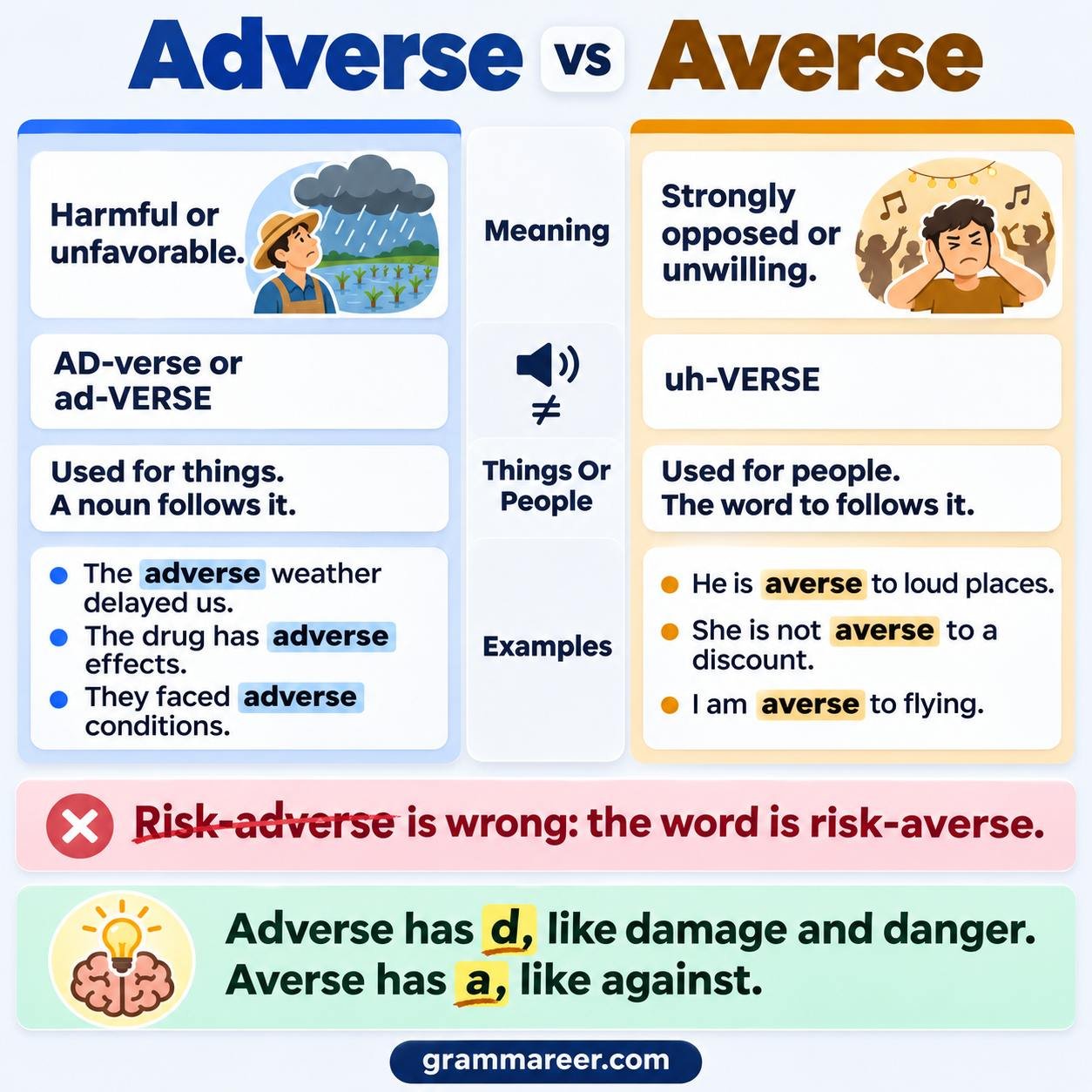
Table of Contents
How They Are Pronounced
The two words differ in stress. Adverse is stressed on the first syllable or the second, as in AD-verse or ad-VERSE, and averse is stressed on the second, as in uh-VERSE. Both end in the same sound, which is why the spellings are confused.
| Adverse | Averse | |
|---|---|---|
| Stress | first or second syllable | second syllable |
| Sounds like | AD-verse or ad-VERSE | uh-VERSE |
| Follows | a noun | “to” |
Meaning Of Adverse
Adverse is an adjective that means harmful, unfavorable or working against something, as in “adverse conditions” and “an adverse reaction to the drug”. It is used before nouns for things such as weather, effects, events and decisions.
Meaning Of Averse
Averse is an adjective that means strongly opposed or unwilling, as in “she is averse to risk”. It is used for people, and it is followed by to. In practice, it most often appears in the negative, as in “he is not averse to a little help”.
How To Check With Harmful Or Opposed
Replace the word with harmful or opposed. If harmful fits, write adverse, and if opposed fits, write averse.
| The sentence | Test | What to write |
|---|---|---|
| The storm had ___ effects on crops. | “harmful effects” works | adverse |
| He is ___ to taking risks. | “opposed to taking risks” works | averse |
| The ___ weather delayed the flight. | “harmful weather” works | adverse |
| I am not ___ to a walk. | “not opposed to a walk” works | averse |
She is adverse to change. ❌
She is averse to change. ✅
Here the word is used for a person and is followed by to, so it is averse.
The medicine had averse side effects. ❌
The medicine had adverse side effects. ✅
The sentence is about a harmful effect, so it is adverse.
Origin Of Adverse And Averse
Both words come from the Latin root meaning to turn. With the prefix ad-, the sense is turning toward, which fits something harmful to us, and with a-, it is turning away, which fits a person who avoids something.
Common Phrases With Adverse And Averse
| Phrase | What it means |
|---|---|
| adverse effect | a harmful result |
| adverse reaction | a harmful response to a drug |
| adverse weather | harsh conditions |
| risk-averse | unwilling to take risks |
| not averse to | willing to |
Word Family Of Adverse And Averse
| Word | Meaning |
|---|---|
| adversely | in a harmful way |
| adversity | hardship |
| aversion | a strong dislike |
| adversary | an opponent |
Memory Trick For Adverse And Averse
Adverse has d, like damage and danger: a harmful thing.
Averse has a, like against: a person who is against something.
If the word is followed by to, the spelling is averse.
Examples Of Adverse And Averse
| Adverse | Averse |
|---|---|
| The adverse weather delayed us. | He is averse to loud places. |
| The drug has adverse effects. | She is not averse to a discount. |
| They faced adverse conditions. | Many people are averse to risk. |
| An adverse ruling was issued. | I am averse to flying. |
FAQs
The key difference is that adverse means harmful or unfavorable and is used for things, whereas averse means strongly opposed or unwilling and is used for people. So adverse weather describes harm, while averse to risk describes a person who dislikes it.
Yes, averse to is correct, because averse is always followed by to, as in "she is averse to risk" and "I am averse to flying".
No, a person cannot be adverse, since people are averse and things are adverse. A sentence such as "She is averse to change" is correct, whereas adverse effects describes harm from a thing.
The noun that goes with averse is aversion, which means a strong dislike. Adversity, by contrast, is the noun related to adverse, and it means hardship.
Yes, adverse is common in formal contexts such as news, medicine and law, as in adverse reaction. A phrase like adverse effects is typical of that kind of writing.
The correct form is risk-averse, because the word describes a person who is unwilling to take risks. Risk-adverse is a misspelling, since adverse is used for harmful things and not for people.
Related: