Allude and elude are verbs that sound nearly the same and differ in meaning: allude means to refer to something indirectly, whereas elude means to escape or avoid. The first syllable is weak in speech, which is why the two are mixed up.
Allude is followed by to, as in “she alluded to the problem”, whereas elude is followed directly by what it avoids, as in “the suspect eluded the police”. Allude can be replaced by refer, and elude by escape.
By the end, you will learn why “the suspect alluded the police” and “she eluded to the problem” are wrong, master the rule of the following to, and memorize a trick for each verb, so you will use allude and elude correctly in an email or an essay.
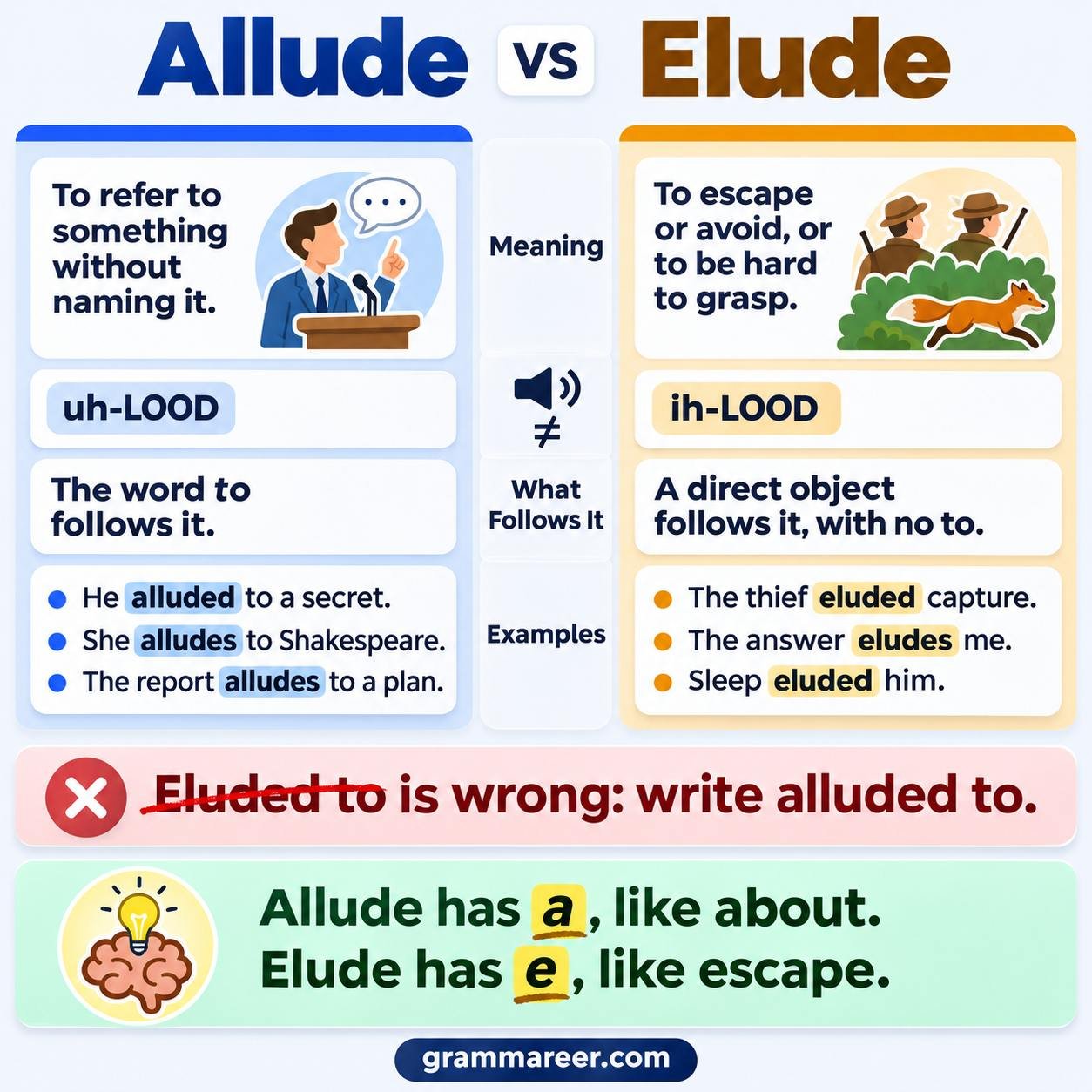
Table of Contents
How They Are Pronounced
The two words differ only in their first sound. Allude begins with a weak uh, as in uh-LOOD, and elude begins with a short ih, as in ih-LOOD. In fast speech the two sounds are close, which is why the spellings are often confused.
Meaning Of Allude
Allude is a verb that means to refer to something indirectly, as in “the speaker alluded to his earlier failure”. It is always followed by to, and the thing mentioned is not named outright.
Meaning Of Elude
Elude is a verb that means to escape from or avoid, as in “the thief eluded the police”. It also means to be hard to understand or remember, as in “the name eludes me”, and in both meanings it has a direct object.
How To Check For A Following To
Look at what follows the verb. If to follows, the verb is allude, whereas if the verb has a direct object, it is elude.
| The sentence | What follows | What to write |
|---|---|---|
| She ___ to her childhood. | “to” | alluded |
| The fox ___ the hunters. | a direct object | eluded |
| He ___ to a famous poem. | “to” | alluded |
| Success ___ him for years. | a direct object | eluded |
The suspect alluded the police. ❌
The suspect eluded the police. ✅
Here the police is the direct object of eluded, with no to.
She eluded to the problem. ❌
She alluded to the problem. ✅
To follows the verb, so it is allude.
Word Family Of Allude And Elude
| Word | Meaning |
|---|---|
| allusion | an indirect reference |
| illusion | a false impression |
| elusive | hard to catch or find |
| allusive | full of indirect references |
| elusion | the act of escaping (rare) |
The nouns allusion and illusion sound alike too, and there is a separate page about them.
Origin Of Allude And Elude
The two verbs look alike because both come from the Latin lūdere, meaning to play. Merriam-Webster traces allude to the Latin allūdere, from ad- and lūdere, with the early meaning of making a playful or mocking allusion to something. It traces elude to ēlūdere, from ex- and lūdere, meaning to trick, avoid or evade. The shared root is why the spelling is so similar, and the different first part marks the different use: allude is for speaking about something, and elude is for getting away from it.
Synonyms For Allude And Elude
| Word | Close synonyms |
|---|---|
| allude | refer to, hint at, mention in passing |
| elude | evade, dodge, escape |
Allude Or Refer
Some style guides prefer refer when a speaker names the subject plainly, and save allude for a hint. That is why, in careful writing, allude is kept for cases where the subject is not named outright.
Memory Trick For Allude And Elude
Allude has a, like about: something is said about a subject without naming it.
Elude has e, like escape: something escapes.
If something runs away or is hard to grasp, the word is elude.
Examples Of Allude And Elude
| Allude | Elude |
|---|---|
| He alluded to a secret. | The thief eluded capture. |
| She alludes to Shakespeare. | The answer eludes me. |
| The report alludes to a plan. | Sleep eluded him. |
| They alluded to the rumor. | The meaning eluded the students. |
FAQs
The key difference is that allude means to mention indirectly, whereas elude means to escape or avoid. So "he alluded to a secret" is a hint, while "the thief eluded capture" is an escape.
Yes, allude takes to, since it is always allude to, as in "She alluded to the problem". Elude, by contrast, has a direct object and no preposition.
Yes, a person can elude a question by avoiding it, and an answer can elude a person by being hard to grasp, as in "The answer eludes me".
The noun for allude is allusion, which means an indirect reference, as in "an allusion to Shakespeare". Like the verb, the noun is followed by to.
The adjective for elude is elusive, which means hard to catch or find. It fits whatever escapes, in the way a thief eludes capture.
Yes, eluded me is correct, and "The name eluded me" means that I could not remember it. The verb has a direct object there, me, and so takes no to.
Related: