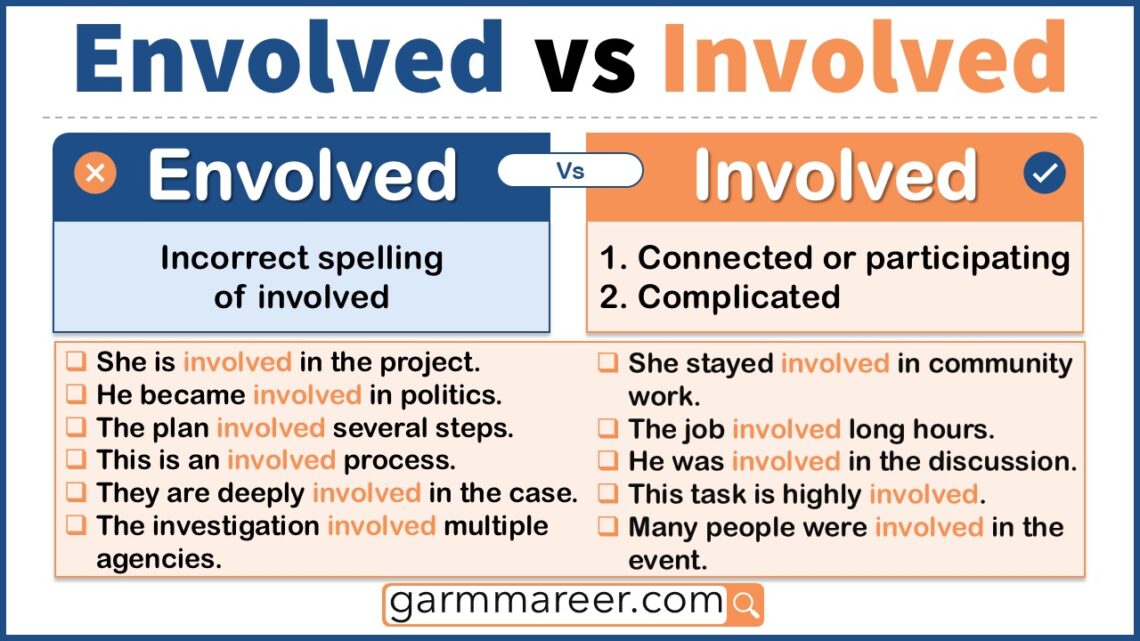
Many English learners confuse Envolved vs Involved because they sound similar when spoken. You may have seen both spellings online and wondered which one is actually correct. The truth is simple: only one of these words is proper English. In this article, we will clearly explain the correct spelling, its meaning, and why the other form is a common mistake, using easy explanations and everyday examples.
Table of Contents
Envolved vs Involved – Meaning
Before we examine the meanings, it’s essential to clarify the confusion. Many people mix up involved and envolved because they sound similar, especially in fast speech. However, only one of these words is correct in standard English. Let’s simply understand them so you can use the right word with confidence.
Involved Meaning
Involved is a correct and commonly used English word. It shows that you take part in something, connect to an activity, or play a role in a situation. It can also describe something complicated or that needs careful attention.
Examples:
- She is deeply involved in her studies.
- He was involved in the project from the beginning.
- The case involved several legal issues.
Envolved Meaning
Envolved is not a correct English word. It is a common spelling mistake and does not appear in standard dictionaries. When people use envolved, they usually mean involved. To avoid errors in writing and speaking, always use involved instead of envolved.
When to Use Involved?
People use the word involved in many everyday situations, so it appears in both formal and casual communication. In general, you use involved when you want to show participation, connection, or responsibility in an activity, situation, or relationship. The context usually makes its meaning clear.
Involved in Professional Writing
In professional writing, people use involved to describe participation, responsibility, or engagement in work-related tasks or processes. It helps explain who took part in a project, decision, or activity without sounding informal.
Examples:
- She helped prepare the final report.
- Several departments took part in the decision-making process.
- The manager actively participates in team planning.
Emotional and Personal Use of Involved
In personal or emotional situations, we use involved to show feelings, relationships, or personal connections. It often suggests care, interest, or emotional attachment.
Examples:
- He is emotionally involved in the story.
- She does not want to get involved in the argument.
- They became involved in a long-term relationship.
What Is the Difference Between Envolved vs Involved?
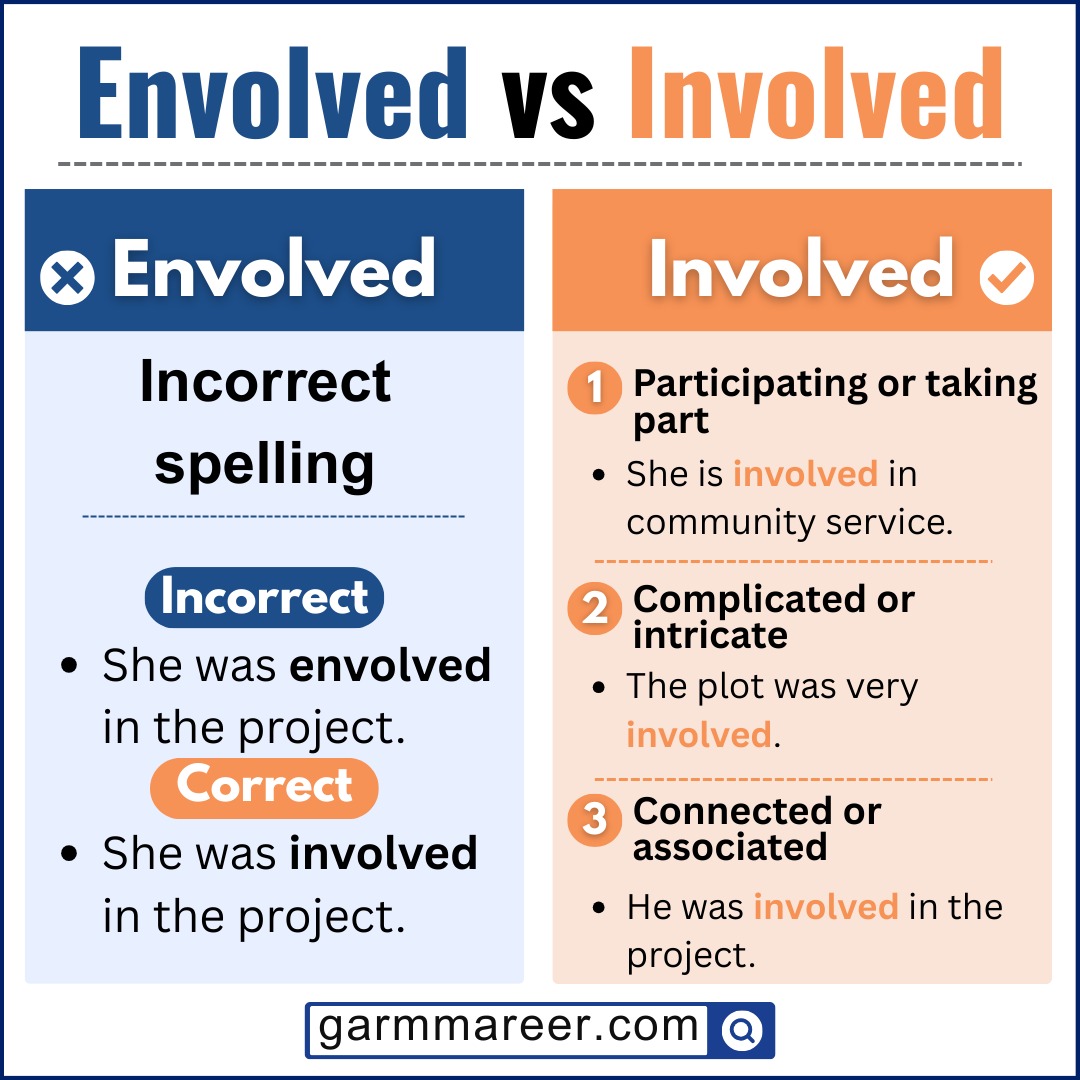
The difference between Envolved vs Involved is actually very simple. Involved is a correct and widely used English word, while envolved is not a real word in standard English.
- Involved means you take part in something, connect to a situation, or play an emotional or practical role. People use it often in both spoken and written English.
- Envolved, on the other hand, is just a spelling mistake. It does not have a meaning and is not accepted in dictionaries. People often write envolved by accident because it sounds similar to involved when spoken quickly.
Examples:
- ❌ Incorrect: He got envolved in the school debate.
- ✅ Correct: He got involved in the school debate.
Common Mistakes With Envolved vs Involved
Many people confuse Envolved and Involved, and that’s completely normal because they sound similar. But once you know the rules, it’s easy to avoid mistakes.
1. Using “Envolved” Instead of “Involved”
The most common mistake is writing envolved. Remember, envolved is not a word. The correct spelling is involved in every situation.
Example:
- ❌ Incorrect: Many departments were envolved in the project.
- ✅ Correct: Many departments were involved in the project.
2. Confusing “Involved” With “Evolve”
Sometimes people mix up involved and evolve because they look a bit similar. But these words mean completely different things:
- Involved = taking part in something or connected to it.
- Evolve = to develop or change over time.
Example:
- ❌Incorrect: She evolved in the project from the beginning.
- ✅ Correct: She was involved in the project from the beginning.
3. Overusing “Involved”
Another mistake is using involved too often in the same sentence or paragraph. Try to mix it with other words like participated, engaged, or took part to make your writing smoother.
By keeping these points in mind, you’ll never confuse involved and envolved again, and your English will sound much more natural.
Examples of Envolved vs Involved
- ❌Incorrect: He was envolved in the new marketing campaign.
- ✅ Correct: He was involved in the new marketing campaign.
- ❌ Incorrect: She became envolved in a debate at school.
- ✅ Correct: She became involved in a debate at school.
- ❌Incorrect: They are envolved in the planning process.
- ✅ Correct: They are involved in the planning process.
- ❌ Incorrect: I accidentally got envolved in their argument.
- ✅ Correct: I accidentally involved myself in their argument.
FAQs About Envolved or Involved
• Involved is a real English word that means taking part in something, being connected to a situation, or having a role in an activity.
• Envolved is not a correct English word. People sometimes use it by mistake, but it does not have any meaning in standard English.
The correct spelling is always involved. Avoid using envolved—it’s a common spelling mistake.
The difference is simple: involved is correct and widely used, while envolved is incorrect.
• Involved = participation, connection, or responsibility
• Envolved = incorrect spelling, does not exist
Use involved whenever you want to show participation, connection, or responsibility. It can be used in:
• Professional writing – describing tasks, projects, or responsibilities
• Personal or emotional contexts – relationships, feelings, or situations
Examples:
• She was involved in organizing the company event.
• He became emotionally involved in the story.
You May Also Like