Neologism simply means a newly created word or expression. You have probably seen many of them in technology, social media, or casual conversations. Language keeps growing as people find new ways to express fresh ideas, and that’s where neologisms come in. In this guide, we’ll look at what neologisms are, why they appear, and a few examples that make the idea easy to get.
Table of Contents
What is a Neologism?
A neologism is simply a new word or phrase that people start using. It might be a completely new term, or it might be an old word that has taken on a new meaning. For example, viral is used to describe illnesses, but now we use it for anything that spreads quickly on the internet.
New words appear because life keeps changing. When we get new ideas, new tools, or new trends, we naturally create new ways to talk about them. Many of these words come from everyday conversations, social media, pop culture, and technology.
Some neologisms become part of our daily language, while others fade away quietly. Once a new word becomes widely used and understood, it eventually gets added to dictionaries and is no longer considered “new.”
Different Types of Neologism
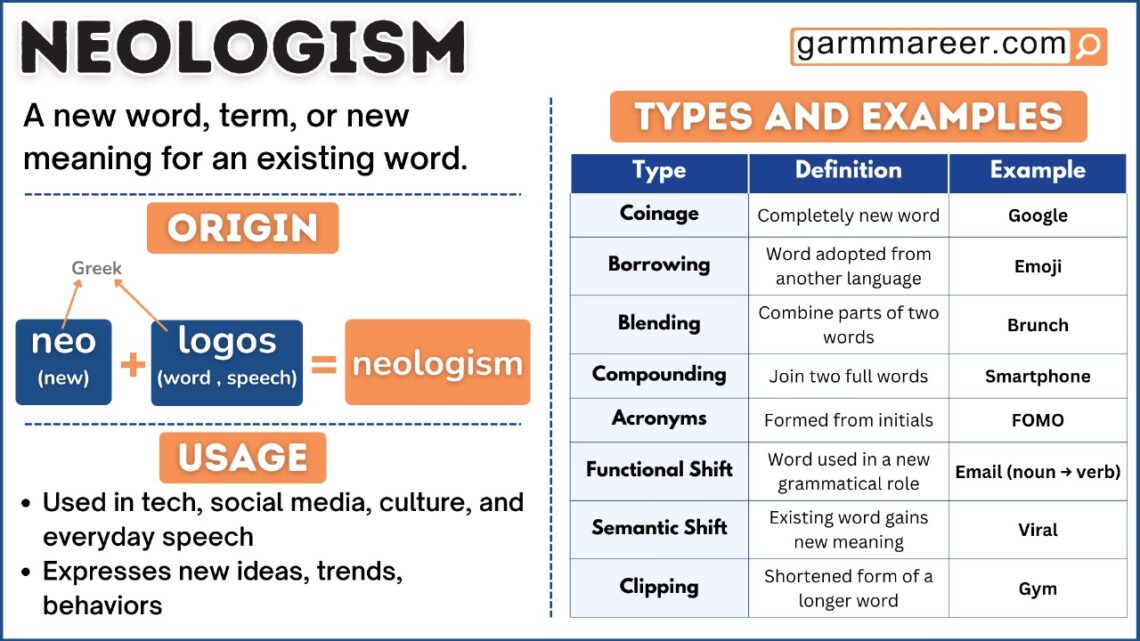
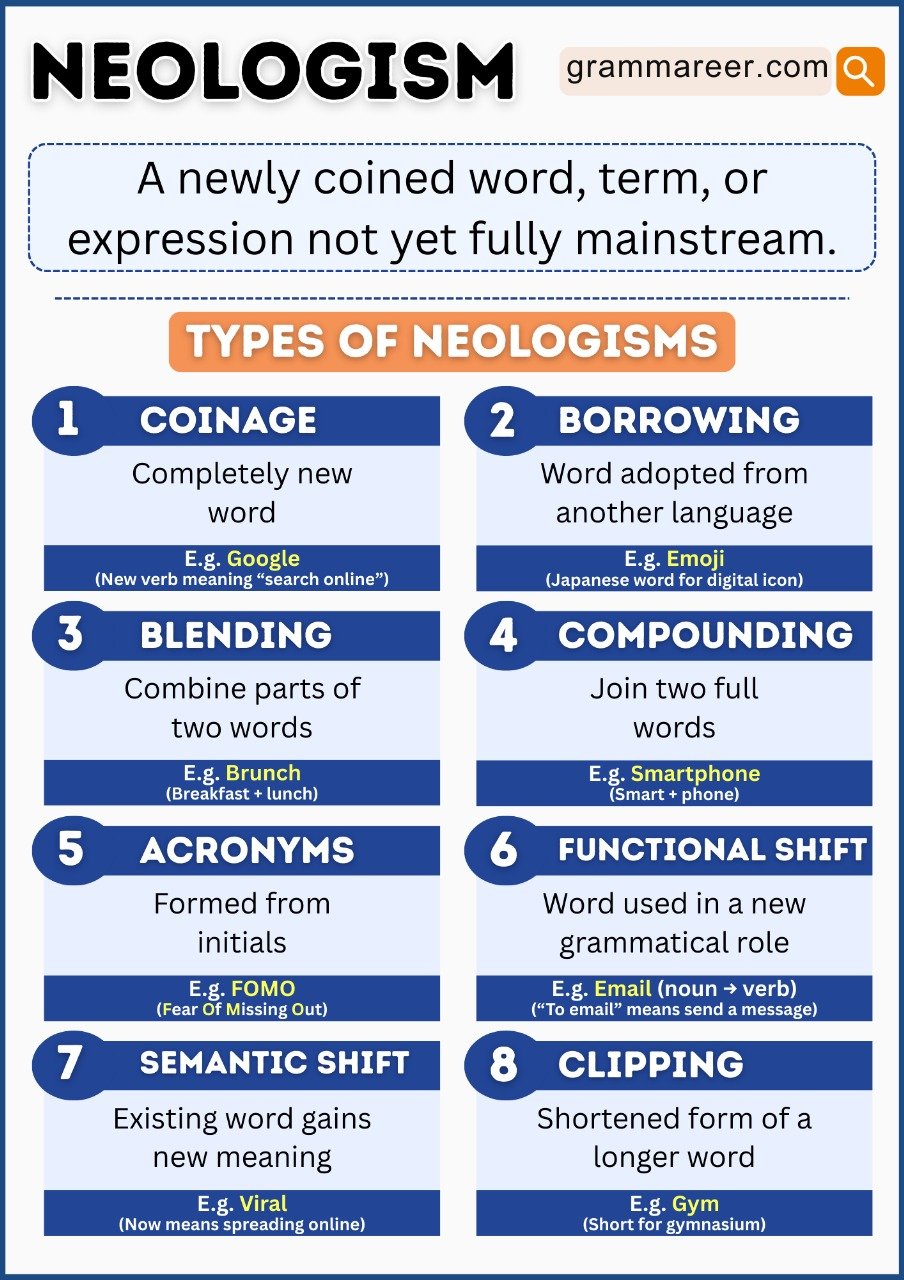
There are many ways new words enter a language. Neologisms can come from everyday conversations, the internet, technology, or even other languages. Here are some common ways they are formed, explained:
| Type of Neologism | Meaning (Simple and Natural) | Example |
|---|---|---|
| Acronyms | A new word formed by using the first letters of a longer phrase. | NASA (National Aeronautics and Space Administration) |
| Clipping | A shorter version of a longer word used in everyday speech. | Exam (examination) |
| Derivation | A new word created by adding a prefix or suffix to an existing word. | Blogger (blog + er) |
| Backformation | A new word formed by removing a part of another word. | Edit (from editor) |
| Compounding | Two full words joined together to make a new word. | Smartphone (smart + phone) |
| Blending | Parts of two words mixed to create a new word. | Smog (smoke + fog) |
| Borrowed Words | Words taken from another language and used in English. | Café (French) |
| New Meanings | An old word that develops an additional new meaning. | Cloud (online storage) |
Examples of Neologism in a Sentence
New words are constantly being created to help us describe things, experiences, or ideas that didn’t exist before. These words often reflect changes in our society, technology, or culture. Here are some examples from everyday life, pop culture, and literature:
Everyday Life and Technology
- Binge-watch: Watching several episodes of a TV show in one sitting.
- Glamping: A mix of “glamorous” and “camping”; camping with comfort and luxury.
- Vlog: Short for “video blog,” a video diary shared online.
- Photobomb: To unexpectedly appear in someone else’s photo, usually as a joke.
- Emoji: Small digital pictures used in messages to express feelings or ideas.
Social Media and Culture
- FOMO: Fear of missing out; the worry that you’re missing exciting events or experiences.
- Ghosting: Suddenly stopping all communication with someone without explanation.
- Selfie: A photo you take of yourself, usually with a smartphone.
- Influencer: Someone who has the power to affect others’ opinions or behavior online.
- Hashtag: A word or phrase preceded by # used to tag topics on social media.
Literature and Creative Works
- Quixotic: Inspired by Don Quixote; describing ideas that are idealistic but unrealistic.
- Robot: First used in Karel Čapek’s play R.U.R. to describe artificial humans.
- Pandemonium: Originally from Milton’s Paradise Lost, meaning a place of chaos or uproar.
- Orwellian: From George Orwell’s 1984, describing an oppressive, controlling society.
Neologisms are everywhere. Some stick around and become part of everyday language, while others fade away. They show just how creative and flexible language can be, letting us describe new things and express ourselves in fresh ways.
FAQs about Neologisms
A neologism is a newly created word or expression, or an existing word given a new meaning. These words often appear to describe new ideas, technologies, or cultural trends.
For example, selfies became popular with the rise of smartphones and social media.
• I stayed home and binge-watched an entire season of my favorite show.
• She is such a foodie; she posts a new recipe on her blog every week.
• He ghosted me after our third date, and I still don’t know why.
• Everyone at the office joined a Zoom meeting from home because of WFH policies.
• During our camping trip, we decided to go glamping instead for more comfort.
Neologisms are new words or expressions that may eventually become part of standard language, while slang is informal language often used by specific groups or communities. A neologism can become slang if it is mainly used informally at first. For example, lit started as slang but is now widely recognized, while blog began as a neologism and became part of standard English.
You May Also Like