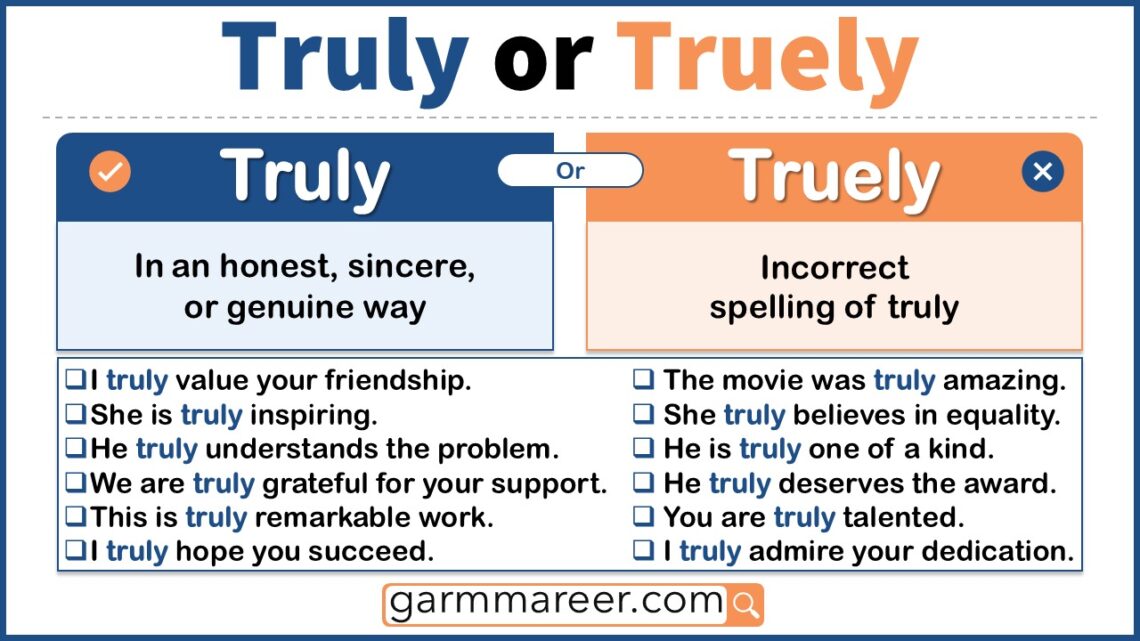
Many people get confused between truly or truely when writing. Which one is correct? In this guide, we’ll clear up the confusion, explain the meaning of truly, and show you some easy examples so you can use it confidently in your writing.
Table of Contents
Truly or Truely – Which One Is Correct?
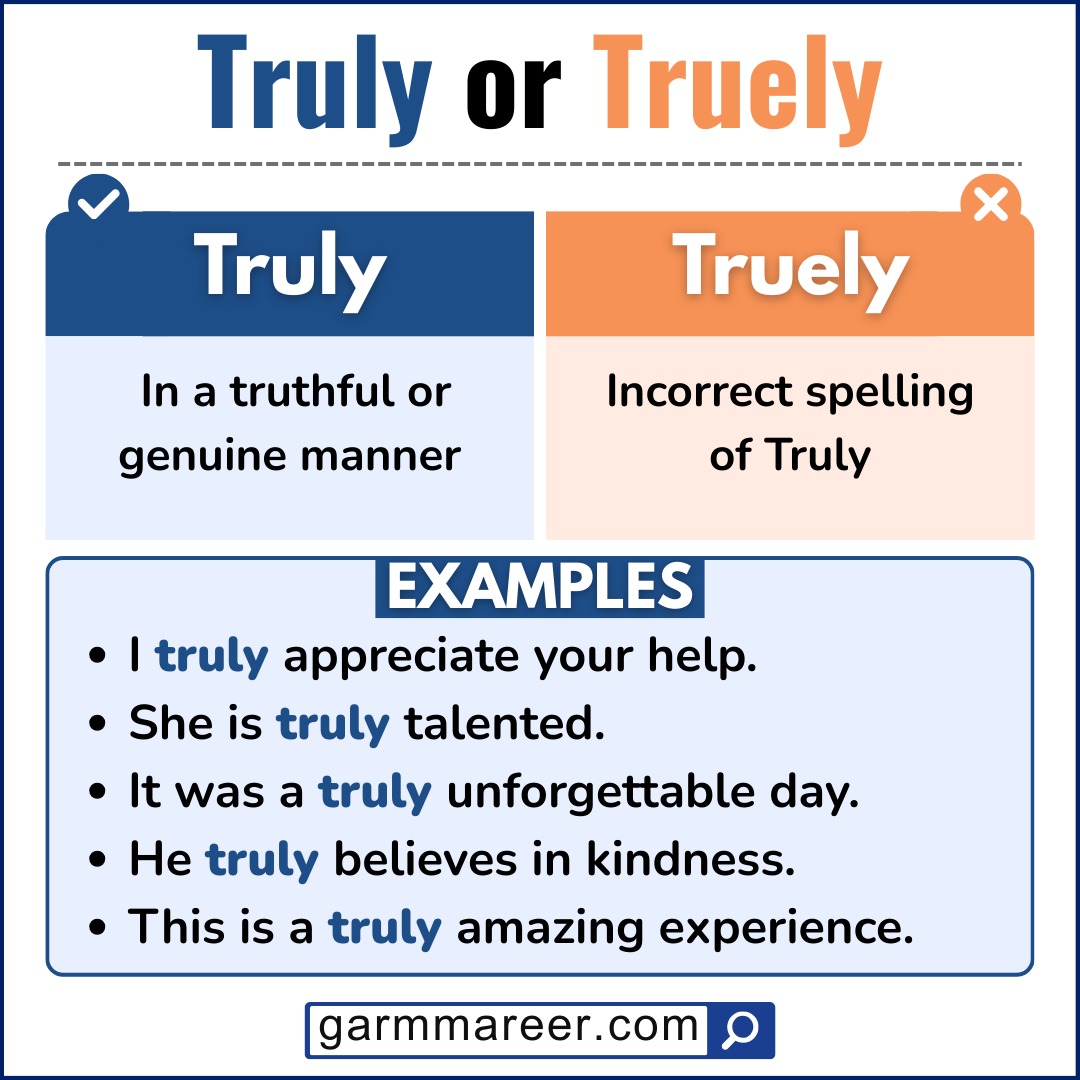
Many people often wonder whether truly or truely is the correct spelling. The truth is, only truly is accurate. It is a common misspelling that you should avoid. Let’s take a closer look at the meanings and examples.
Truly Meaning
“Truly” is an adverb used to show honesty, sincerity, or something genuine.
Examples:
- I truly appreciate your help.
- She truly believes in hard work.
- This is truly a beautiful place.
Truely Meaning
It is not a correct word in English. If you see it in writing, it is just a spelling mistake. Always use truly instead.
How to Use Truly or Truely?
The word truly is the correct spelling and is used to express honesty, sincerity, or something genuine. It is an adverb, so it often comes before or after a verb, or at the end of a sentence to emphasize truth or reality.
On the other hand, truely is always incorrect. It’s a common spelling mistake, so you should never use it in writing.
Examples:
- ❌ Incorrect: I truely enjoy spending time with my family.
- ✅ Correct: I truly enjoy spending time with my family.
Always remember, there is only one “e” in truly. That’s the correct way to spell it.
Common Mistake: Truely vs Truly
Many people mistakenly write truely thinking it is correct, but this is always wrong. The correct spelling is truly with only one “e”.
Using truely in writing can make your text look careless, especially in formal writing, emails, or articles. It’s an easy mistake to avoid once you remember the correct spelling.
Examples:
- ❌ Incorrect: I truely appreciate your support. ❌
- ✅ Correct: I truly appreciate your support.
- ❌ Incorrect: She truely loves reading books. ❌
- ✅ Correct: She truly loves reading books.
Tips to Remember the Difference
If truely ever feels tempting to write, here’s an easy way to stop yourself. The correct spelling is truly, and it simply drops the extra e.
A quick way to remember this is to think: shorter is correct. English often removes letters when forming adverbs, and truly follows that pattern.
Whenever you hesitate, just remember this rule:
If it has an extra “e,” it’s wrong.
Examples of Truly or Truely
Example 1:
❌ Incorrect: I truely appreciate your honesty.
✅ Correct: I truly appreciate your honesty.
Example 2:
❌ Incorrect: She was truely excited about the new opportunity.
✅ Correct: She was truly excited about the new opportunity.
Example 3:
❌ Incorrect: This place is truely special to me.
✅ Correct: This place is truly special to me.
Example 4:
❌ Incorrect: He truely believes hard work pays off.
✅ Correct: He truly believes hard work pays off.
FAQs
No, it is not a real English word. It is a common spelling mistake. The correct and accepted spelling in English is truly.
You should always use truly. If you write truely, it will be considered incorrect in both formal and informal writing.
Use truly when you want to express honesty, sincerity, or something genuine. It fits naturally in everyday conversations, writing, and professional communication.
Examples:
• I truly understand your concern.
• She truly cares about her work.
You May Also Like